Expert Real Estate Team: Your Trusted Source for Up-to-Date Real Estate Knowledge

Welcome to the Expert Real Estate Team blog! Whether you're a seasoned realtor, a homeowner looking to sell, or a first-time buyer embarking on your real estate journey, we're here to be your trusted source of valuable information. 

Our blog is packed with insightful articles and expert advice on a wide range of real estate topics. We cover everything from market trends and local insights to navigating the buying and selling process, financing options, and homeownership tips. 

Here's what you can expect:

  • Realtors: Stay ahead of the curve with market updates, marketing strategies, legal and regulatory changes, and expert tips to elevate your real estate career. 
  • Sellers: Get inside knowledge on preparing your home for sale, maximizing your return on investment, and navigating negotiations with confidence. 
  • Buyers: Learn about different mortgage options, discover the secrets to successful homefinding, understand local market dynamics, and make informed decisions. 

Our goal is to empower you with the knowledge and tools you need to achieve your real estate goals. We believe in fostering a community of informed and confident real estate professionals and homeowners. 


July 20, 2020

Thinking of Selling Your House? Now May be the Right Time

Thinking of Selling Your House? Now May be the Right Time | MyKCM

Inventory is arguably the biggest challenge for buyers in today’s housing market. There are simply more buyers actively looking for homes to purchase than there are sellers selling them, so the scale is tipped in favor of the sellers.

According to the latest Existing Home Sales Report from the National Association of Realtors (NAR), total housing inventory is down 18.8% from one year ago. Inventory is well below what was available last year, and the houses that do come to the market are selling very quickly.

Sam Khater, Chief Economist at Freddie Mac notes:

“Simply put, new housing supply is not keeping up with rising demand. We estimate that the housing market is undersupplied by 3.3 million units, and the shortage is rising by about 300,000 units a year. More than half of all states have a housing shortage.”

Why is inventory so low?

There are many reasons why it’s hard to find a home to buy today, stemming from an undersupply of newly constructed homes to sellers pressing pause on their moving plans due to the current health pandemic. One of the key factors making it even more challenging, however, is the amount of time current homeowners are staying in their homes. There has truly been a fundamental shift in the market that started about 10 years ago: people are staying put longer, and it’s contributing to the shortage of houses for sale.

In the 2019 Profile of Home Buyers and Sellers, NAR explained:

“In 2019, the median tenure for sellers was 10 years…After 2008, the median tenure in the home began to increase by one year each year. By 2011, the median tenure reached nine years, where it remained for three consecutive years, and jumped up again in 2014 to 10 years.”

As shown in the graph below, historical data indicates that staying in a home for 5-7 years used to be the norm, until the housing bubble burst. Since 2010, that length of time has trended upward, toward 9-10 years, largely due to homeowners aiming to recoup their equity:Thinking of Selling Your House? Now May be the Right Time | MyKCMThankfully, with the strength the market has gained over the last 10 years, today’s homeowners are in a much better equity position. Now is a fantastic time for homeowners who are ready to make a move to break the 10-year trend and sell their houses, especially while buyer demand is so high and inventory is so low. It’s a prime time to sell.

In addition, with today’s historically low interest rates, there’s an opportunity for sellers to maintain a low monthly payment while getting more house for their money. Think: move-up opportunity, more square footage, or finding the features they’re really looking for rather than doing costly renovations. With more new homes poised to enter the market this year, homeowners ready to make a move may have a golden opportunity to do so right now.

Bottom Line

There are simply not enough houses for sale today. If you’re ready to leverage your equity and sell your house, let’s connect today. It’s a great time to move while demand for homes to buy is extremely high.

July 17, 2020

Mortgage Rates Fall Below 3%

Mortgage Rates Fall Below 3% [INFOGRAPHIC] | MyKCM

  • Mortgage rates hit another all-time low, falling below 3% this week.
  • If you’re ready to buy a home, now is a great time to truly get more for your money at this historic moment.
  • Let’s connect today to determine your best next steps toward homeownership.
July 13, 2020

The Summer Housing Market is Heating Up

The Summer Housing Market is Heating Up 

Showings have increased following the spring decline and buyers are ready to make a big move. But overall, we need more sellers in the market to satisfy the demand. Watch the video to get all the details of buying and selling in today's unprecedented market.

July 7, 2020

What Are Experts Saying About the Rest of 2020?

One of the biggest questions on everyone’s minds these days is: What’s going to happen to the housing market in the second half of the year? Based on recent data on the economy, unemployment, real estate, and more, many economists are revising their forecasts for the remainder of 2020 – and the outlook is extremely encouraging. Here’s a look at what some experts have to say about key areas that will power the industry and the economy forward this year.

Mortgage Purchase Originations: Joel Kan, Associate Vice President of Economic and Industry ForecastingMortgage Bankers Association

“The recovery in housing is happening faster than expected. We anticipated a drop off in Q3. But, we don’t think that’s the case anymore. We revised our Q3 numbers higher. Before, we predicted a 2 percent decline in purchase originations in 2020, now we think there will be 2 percent growth this year.”

Home Sales: Lawrence Yun, Chief Economist, National Association of Realtors

“Sales completed in May reflect contract signings in March and April – during the strictest times of the pandemic lock down and hence the cyclical low point…Home sales will surely rise in the upcoming months with the economy reopening, and could even surpass one-year-ago figures in the second half of the year.”

Inventory: George Ratiu, Senior Economist, realtor.com

“We can project that the next few months will see a slow-yet-steady improvement in new inventory…we projected a stepped improvement for the May through August months, followed by a return to historical trend for the September through December time frame.”

Mortgage Rates: Freddie Mac

“Going forward, we forecast the 30-year fixed-rate mortgage to remain low, falling to a yearly average of 3.4% in 2020 and 3.2% in 2021.”

New Construction: Doug Duncan, Chief Economist, Fannie Mae

“The weaker-than-expected single-family starts number may be a matter of timing, as single-family permits jumped by a stronger 11.9 percent. In addition, the number of authorized single-family units not yet started rose 5.4 percent to the second-highest level since 2008. This suggests that a significant acceleration in new construction will likely occur.”

Bottom Line

The experts are optimistic about the second half of the year. If you paused your 2020 real estate plans this spring, let’s connect today to determine how you can re-engage in the process.

July 6, 2020

Are New Homes Going to Be Available to Buy This Year?

In today’s economy, everyone seems to be searching for signs that a recovery is coming soon. Many experts agree that it may actually already be in motion or will be starting by the 3rd quarter of this year. With the housing market positioned to lead the way out of this recession, builder confidence might be a bright spark that gets the recovery fire started. The construction of new homes coming right around the corner is a huge part of that effort, and it may drive your opportunity to make a move this year.

According to the National Association of Home Builders (NAHB): 

“New home sales jumped in May, as housing demand was supported by low interest rates, a renewed household focus on housing, and rising demand in lower-density markets. Census and HUD estimated new home sales in May at a 676,000 seasonally adjusted annual pace, a 17% gain over April.” 

In addition, builder confidence is also rising, opening up opportunity for newly constructed homes in the market. The NAHB also notes:

“In a sign that housing stands poised to lead a post-pandemic economic recovery, builder confidence in the market for newly-built single-family homes jumped 21 points to 58 in June, according to the latest National Association of Home Builders/Wells Fargo Housing Market Index (HMI). Any reading above 50 indicates a positive market.”

As noted above, this upward trend is supported by builders reporting an increase in demand for single-family homes in suburban neighborhoods with lower-densitypopulations, a result of the COVID-19 health crisis.

Moreover, the most recent Monthly New Residential Construction Report from the U.S. Censusindicates that authorized building permits for new residential construction increased by 14.4% month-over-month from April to May, and housing starts were also up 4.3%over the same time period. (See graph below):Are New Homes Going to Be Available to Buy This Year? | MyKCMAlthough housing permits and starts are both considerably lower than they were at this time last year, indicating the new construction market is still working on building its way back up, the trends are moving in the right direction when it comes to having an impact on the U.S. economy. They’re also poised to create the much-needed new homes for Americans to purchase in a time when inventory is so scarce.

Dean Mon, Chairman of the NAHB notes:

“As the nation reopens, housing is well-positioned to lead the economy forward…Inventory is tight, mortgage applications are increasing, interest rates are low and confidence is rising. And buyer traffic more than doubled in one month even as builders report growing online and phone inquiries stemming from the outbreak.”

The gap between homes to buy and the high demand from purchasers may be narrowed by new construction, and the data shows that these homes are on their way into the housing market.

So, if you’ve debated whether or not to sell your house this year because you’re not sure where to move, a newly-built home – designed to your specific liking – may be your answer.

Bottom Line

With new residential construction right around the corner, you can feel confident about selling your house and having a place to move into. Maybe it’s time to finally design the home you’ve always wanted. Let’s connect today to discuss selling your house while demand from eager buyers is high.

July 3, 2020

Is the Health Crisis Driving Buyers Out of Urban Areas?

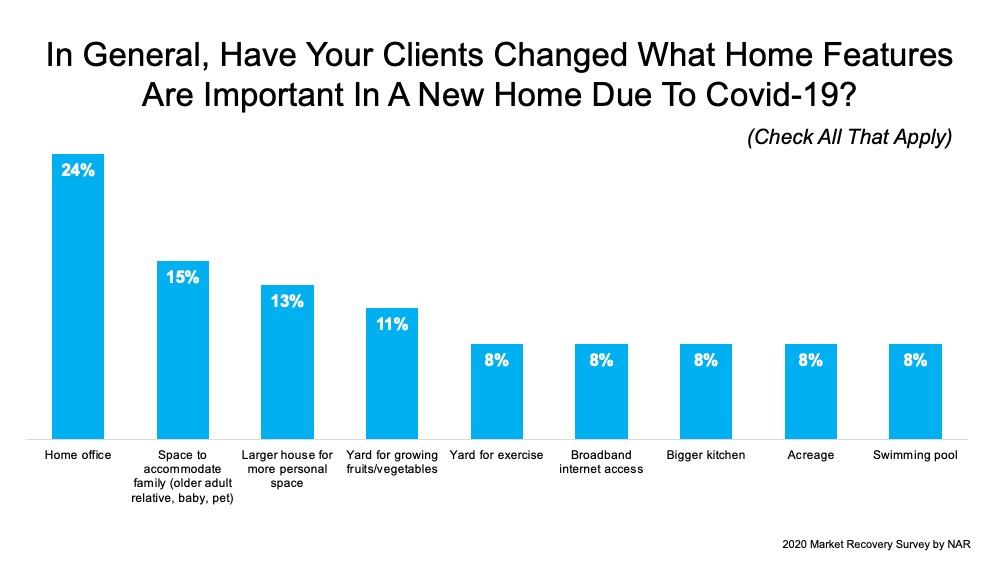
The pandemic has caused consumers to re-examine the components that make up the “perfect home.” Many families are no longer comfortable with the locations and layouts of their existing homes. The allure of city life (more congested) seems to be giving way to either suburban or rural life (less congested). The fascination with an open floor plan seems to be fading as people are finding a need for more privacy while working from home.

Recently, news.com released a report that revealed how buyers’ views of listings are leaning heavily to more suburban and rural properties. Here are the year-over-year percentage increases in views per property type:

  • Urban – 7%
  • Suburban – 13%
  • Rural – 16%

In the report, Javier Vivas, Director of Economic Research for realtor.com, gives these numbers some context:

“This migration to the suburbs is not a new trend, but it has become more pronounced. After several months of shelter-in-place orders, the desire to have more space and the potential for more people to work remotely are likely two of the factors contributing to the popularity of the burbs.”

Realtor Magazine also just reported that the desire to move is strongest in our city markets:

“Nearly 30% of respondents living in a high-density urban area say that the pandemic is prompting them to want to move by the end of the year…This is more than double the rate of those living in rural parts of the country, where residents are much more likely to stay put rather than to relocate.”

New Construction Also Seeing a Surge in Views

Since the pandemic has altered how consumers think about floor plans, builders are anticipating how future homes will change. In a recent press release by Zillow, it was explained that:

  • Builders believe as people spend more time at home during the pandemic, buyers are realizing which features of their homes are working and not working.
  • Homebuilders predict open-concept floor plans will be a thing of the past, as people now value more walls, doors, and overall privacy.
  • New construction, which offers the chance to personalize home features, saw its listing page views grow by 73% over last May.

The Virus is Even Impacting the Luxury Second-Home Market

It appears that COVID-19 is impacting the luxury market too. In an article released last week titled, Luxury Buyers Return to Market in Force, Danielle Hale, Chief Economist for realtor.comreported:

“Stay at home orders and social distancing have put a new value on the extra space. We’re seeing this in the luxury market as well, which could mean there is renewed interest from high-end buyers to find a second-home that is within driving distance from their primary residence.

Much like the suburbs are gaining favor with home shoppers, second home markets are seeing increased interest from luxury buyers…Views of luxury properties accelerated 56% in The Hamptons, 28% in Palm Springs and 24% in Greenwich compared to January trends.”

Bottom Line

It appears that a percentage of people are preparing to leave many American cities. Some of these moves will be permanent, while others will be temporary (such as a getaway to a second home). In either case, many consumers are on the move. Real estate professionals are ready and willing to help in any way they can.

July 2, 2020

A Historic Rebound for the Housing Market

Pending Home Sales increased by 44.3% in May, registering the highest month-over-month gain in the index since the National Association of Realtors (NAR) started tracking this metric in January 2001. So, what exactly are pending home sales, and why is this rebound so important?

According to NAR, the Pending Home Sales Index (PHS) is:

“A leading indicator of housing activity, measures housing contract activity, and is based on signed real estate contracts for existing single-family homes, condos, and co-ops. Because a home goes under contract a month or two before it is sold, the Pending Home Sales Index generally leads Existing-Home Sales by a month or two.”

In real estate, pending home sales is a key indicator in determining the strength of the housing market. As mentioned before, it measures how many existing homes went into contract in a specific month. When a buyer goes through the steps to purchase a home, the final one is the closing. On average, that happens about two months after the contract is signed, depending on how fast or slow the process takes in each state.

Why is this rebound important?

With the COVID-19 pandemic and a shutdown of the economy, we saw a steep two-month decline in the number of houses that went into contract. In May, however, that number increased dramatically (See graph below):A Historic Rebound for the Housing Market | MyKCMThis jump means buyers are back in the market and purchasing homes right now. Lawrence Yun, Chief Economist at NAR mentioned:

“This has been a spectacular recovery for contract signings and goes to show the resiliency of American consumers and their evergreen desire for homeownership…This bounce back also speaks to how the housing sector could lead the way for a broader economic recovery.”

But in order to continue with this trend, we need more houses for sale on the market. Yun continues to say:

“More listings are continuously appearing as the economy reopens, helping with inventory choices…Still, more home construction is needed to counter the persistent underproduction of homes over the past decade.”

As we move through the year, we’ll see an increase in the number of houses being built. This will help combat a small portion of the inventory deficit. The lack of overall inventory, however, is still a challenge, and it is creating an opportunity for homeowners who are ready to sell. As the graph below shows, during the last 12 months, the supply of homes for sale has been decreasing year-over-year and is not keeping up with the demand from homebuyers.A Historic Rebound for the Housing Market | MyKCM

Bottom Line

If you decided not to sell this spring due to the health crisis, maybe it’s time to jump back into the market while buyers are actively looking for homes. Let’s connect today to determine your best move forward.


June 18, 2020

Want to Make a Move? Homeowner Equity is Growing Year-Over-Year

Want to Make a Move? Homeowner Equity is Growing Year-Over-Year | MyKCM

One of the bright spots of the 2020 real estate market is the growth in equity homeowners are experiencing across the country. According to the recently released Homeowner Equity Insights Report from CoreLogic, in nearly every state there was a year-over-year first-quarter equity increase, averaging out to a 6.5% overall gain.

The report notes:

“CoreLogic analysis shows U.S. homeowners with mortgages (roughly 63% of all properties) have seen their equity increase by a total of nearly $590 billion since the first quarter of 2019, an increase of 6.5%, year over year.” (See map below):

Want to Make a Move? Homeowner Equity is Growing Year-Over-Year | MyKCMThis means that In the first quarter of 2020, the average homeowner gained approximately $9,600 in equity during the past year.”

That’s a huge win for homeowners, especially for those looking to sell their houses and make a move this summer. Having equity to re-invest in your next home is a major force that can make moving a reality, especially while buyers are expressing such a high demand for homes to purchase.

Frank Martell, President and CEO of CoreLogic addresses the potential long-term outlook and how homeowners will likely fare much more positively through the current recession than many did during the last one:

“Many homeowners will experience a recession during their lifetime, and it is reasonable to compare the current recession to those in the past. But the comparison is not apples to apples — every recession is different. Primary drivers of the Great Recession were an overbuilt housing stock, risky mortgages and the collapse of home prices, creating a massive increase in negative equity that proved difficult to recover from. Today’s housing environment has low vacancy and delinquency rates and a large home equity cushion.”

Bottom Line

Now is a great time to consider leveraging your equity and making a move, especially while buyer interest is high. Let’s connect to explore your equity position and make your next move a reality.

June 17, 2020

Three Reasons Homebuyers Are Ready to Purchase This Year

Three Reasons Homebuyers Are Ready to Purchase This Year | MyKCM

A recent survey by Lending Tree tapped into behaviors of over 1,000 prospective buyers. The results indicated 53% of all homebuyers are more likely to buy a home in the next year, even amid the current health crisis. The survey further revealed why, naming several reasons buyers are more likely to move this year (see graph below):Three Reasons Homebuyers Are Ready to Purchase This Year | MyKCMLet’s break down why these are a few of the key factors motivating buyers to actively engage in the home search process, and the corresponding wins for sellers as well.

1. Low Mortgage Rates

The biggest reason potential homebuyers indicated they’re eager to purchase this year is due to current mortgage rates, which are hovering near all-time lows. Today’s low rates are making it more affordable than ever to buy a home, which is a huge incentive for purchasers. In fact, 67% of respondents in the Lending Tree survey want to take advantage of low mortgage rates. This is no surprise when comparing historic mortgage rates by decade (see below):Three Reasons Homebuyers Are Ready to Purchase This Year | MyKCMSam Khater, Chief Economist at Freddie Mac recently said:

“As the economy is slowly rebounding, all signs continue to point to a solid recovery in home sales activity heading into the summer as prospective buyers jump back into the market. Low mortgage rates are a key factor in this recovery.”

2. Reduced Spending

Some people have also been able to save a little extra money over the past few months while sheltering in place. One of the upsides of staying home recently is that many have been able to work remotely and minimize extra spending on things like commuting expenses, social events, and more. For those who fall into this category, they may have a bit more saved up for down payments and closing costs, making purchasing a home more feasible today.

3. Re-Evaluating Their Space

Spending time at home has also given buyers a chance to really evaluate their living space, whether renting or as a current homeowner. With time available to craft a wish list of what they really need in their next home, from more square footage to a more spacious neighborhood, they’re ready to make it happen.

What does this mean for buyers and sellers?

With these three factors in play, the demand for housing will keep growing this year, especially over the summer as more communities continue their phased approach to reopening. Buyers can take advantage of additional savings and low mortgage rates. And if you’re thinking of selling, know that your home may be in high demand as buyer interest grows and the number of homes for sale continues to dwindle. This may be your moment to list your house and make a move into a new space as well.

Bottom Line

If you’re ready to buy or sell – or maybe both – let’s connect to put your plans in motion. With low mortgage rates leading the way, it’s a great time to take advantage of your position in today’s market.

June 10, 2020

Real Estate Will Lead the Economic Recovery

Real Estate Will Lead the Economic Recovery | MyKCM

With more U.S. states reopening for business this summer, and as people start to return to work, we can expect the economy to begin improving. Most expert forecasts indicate this economic recovery will start to happen in the second half of this year. As we get back to work and the financial landscape of the country begins to turn around, many experts also agree that real estate has the potential to lead the way in the recovery process.

According to Ivy Zelman of Zelman & Associates:

 “Housing will fare better than expected during this severe downturn.”

In addition, CNBC notes:

“Mortgage demand from home buyers shows unexpectedly strong and quick recovery…The quick recovery has surprised most forecasters.”

Robert Dietz, Chief Economist and Senior Vice President for Economics and Housing Policy of the National Association of Home Builders (NAHB) says:

“Overall, the data lend evidence to the NAHB forecast that housing will be a leading sector in an eventual economic recovery.”

One of the big reasons why housing has the potential to be such a driving force is the significant impact it has on the local economy. This impact is particularly strong when a newly constructed home is built and sold. According to a recent study by the National Association of Realtors (NAR), the average new home sale has a total economic impact of $88,416. As outlined in the graphic below, this is a combination of income generated from real estate industries, expenditures, and new home construction.Real Estate Will Lead the Economic Recovery | MyKCMWith so many unknowns today, especially in the wake of a worldwide pandemic, one known factor is the bright spark the housing market can play in local and national recovery. Buying and selling a home goes well beyond personal growth and satisfaction – it supports our economy as a whole.

Bottom Line

According to experts, the economy will begin to recover in the second half of this year. With real estate as a driver, that recovery may start sooner than we think.