Expert Real Estate Team: Your Trusted Source for Up-to-Date Real Estate Knowledge

Welcome to the Expert Real Estate Team blog! Whether you're a seasoned realtor, a homeowner looking to sell, or a first-time buyer embarking on your real estate journey, we're here to be your trusted source of valuable information. 

Our blog is packed with insightful articles and expert advice on a wide range of real estate topics. We cover everything from market trends and local insights to navigating the buying and selling process, financing options, and homeownership tips. 

Here's what you can expect:

  • Realtors: Stay ahead of the curve with market updates, marketing strategies, legal and regulatory changes, and expert tips to elevate your real estate career. 
  • Sellers: Get inside knowledge on preparing your home for sale, maximizing your return on investment, and navigating negotiations with confidence. 
  • Buyers: Learn about different mortgage options, discover the secrets to successful homefinding, understand local market dynamics, and make informed decisions. 

Our goal is to empower you with the knowledge and tools you need to achieve your real estate goals. We believe in fostering a community of informed and confident real estate professionals and homeowners. 


May 6, 2020

How to Test-Drive a Neighborhood While Sheltering in Place

How to Test-Drive a Neighborhood While Sheltering in Place [INFOGRAPHIC] | MyKCM


How to Test-Drive a Neighborhood While Sheltering in Place [INFOGRAPHIC]

How to Test-Drive a Neighborhood While Sheltering in Place [INFOGRAPHIC] | MyKCM

Some Highlights

  • Staying at home doesn’t mean your search for a new place needs to come to a standstill.
  • Check out these tips on how to explore other neighborhoods virtually in the homebuying process. You may find a spot that better suits your needs without ever leaving your living room!
  • Let’s connect today so you have help with all of the additional steps along the way, and you’re ready to make your next move.
May 5, 2020

Confused About the Economic Recovery? Here’s Why.

Confused About the Economic Recovery? Here’s Why. | MyKCM

As we continue to work through the health crisis that plagues this country, more and more conversations are turning to economic recovery. While we look for signs that we’ve reached a plateau in cases of COVID-19, the concern and fear of what will happen as businesses open up again is on all of our minds. This causes confusion about what an economic recovery will look like. With this in mind, it’s important to understand how economists are using three types of sciences to formulate their forecasts and to work toward clearer answers.
  1. Business Science – How has the economy rebounded from similar slowdowns in the past?
  2. Health Science – When will COVID-19 be under control? Will there be another flareup of the virus this fall?
  3. People Science – After businesses are fully operational, how long will it take American consumers to return to normal consumption patterns? (Ex: going to the movies, attending a sporting event, or flying).
Sam Khater, Chief Economist at Freddie Mac, says:
“Although the uncertainty of the crisis means forecasts of economic activity are more unclear than usual, we expect that most of the economic damage from the virus will be contained to the first half of the year. Going forward, we should see a recovery starting in the second half of 2020.”
This past week, the Bureau of Economic Analysis released the advanced estimate for Gross Domestic Product (GDP) for the first quarter of 2020. That estimate came in at -4.8%. It was a clear indicator showing how the U.S. economy slowed as businesses shut down and consumers retreated to their homes in fear of the health crisis and of contracting COVID-19.Confused About the Economic Recovery? Here’s Why. | MyKCMExperts agree that the second quarter of 2020 will be an even greater slowdown, a sign more businesses are feeling the effects of this health crisis. The same experts, however, project businesses will rebound, and a recovery will start to happen in the second half of this year.

Bottom Line

As time goes on, we’ll have more clarity around what the true economic recovery will look like, and we’ll have more information on the sciences that will affect it. As the nation’s economy comes back to life and businesses embrace new waves of innovation to serve their customers, the American spirit of grit, growth, and prosperity will be alive and well.


May 4, 2020

U.S. Homeownership Rate Rises to Highest Point in 8 Years

U.S. Homeownership Rate Rises to Highest Point in 8 Years | MyKCM

For nearly two months, most of us have been following strict stay-at-home orders from our state and local governments. It is a whole new way of life that has put our daily lives on pause. On the other hand, many of us have also found a sense of comfort by slowing down and spending time at home, highlighting the feeling of security that comes with having a much-needed safe place for our families to live. The latest results of the Housing Vacancy Survey (HVS) provided by the U.S. Census Bureau shows how Americans place immense value in homeownership, and it is continuing to grow in the United States. The results indicate that the homeownership rate increased to 65.3% for the first quarter of 2020, a number that has been rising since 2016 and is the highest we’ve seen in eight years (see graph below):U.S. Homeownership Rate Rises to Highest Point in 8 Years | MyKCMWhy is the rate increasing? The National Association of Home Builders (NAHB) explained:

“Strong owner household formation with around 2.7 million homeowners added in the first quarter has driven up the homeownership rate, especially under the decreasing mortgage interest rates and strong new home sales and existing home sales in the first two months before the COVID-19 pandemic hit the economy.”

The NAHB also emphasizes the year-over-year increase in each generational group:

“The homeownership rates among all age groups increased in the first quarter 2020. Households under 35, mostly first-time homebuyers, registered the largest gains, with the homeownership rate up 1.9 percentage points from a year ago. Households ages 35-44 experienced a 1.2 percentage points gain, followed by the 55-64 age group (a 0.9 percentage point increase), the 45-54 age group (a 0.8 percentage point gain), and the 65+ group age (up by 0.2 percentage point).” (See chart below):

U.S. Homeownership Rate Rises to Highest Point in 8 Years | MyKCMHomeownership is an important part of the American dream, especially in moments like this when many are feeling incredibly grateful for the home they have to shelter in place with their families. COVID-19 may be slowing our lives down, but it is showing us the emotional value of homeownership too.

Bottom Line

If you’re considering buying a home this year, let’s connect to set a plan that will help you get one step closer to achieving your dream.

April 24, 2020

Keys to Selling Your House Virtually

Keys to Selling Your House Virtually | MyKCM

In a recent survey by realtor.com, people thinking about selling their homes indicated they’re generally willing to allow their agent and some potential buyers inside if done under the right conditions. They’re less comfortable, however, hosting an open house. This is understandable, given the health concerns associated with social contact these days. The question is, if you need to sell your house now, what virtual practices should you use to make sure you, your family, and potential buyers stay safe in the process?

In today’s rapidly changing market, it’s more important than ever to make sure you have a digital game plan and an effective online marketing strategy when selling your house. One of the ways your agent can help with this is to make sure your listing photos and virtual tours stand out from the crowd, truly giving buyers a detailed and thorough view of your home.

So, if you’re ready to move forward, virtual practices may help you win big when you’re ready to sell. While abiding by state and local regulations is a top priority, a real estate agent can help make your sale happen. Agents know exactly what today’s buyers need, and how to put the necessary digital steps in place. For example, according to the same survey, when asked to select what technology would be most helpful when deciding on a new home, here’s what today’s homebuyers said, in order of preference:

  • Virtual tour of the home
  • Accurate and detailed listing information
  • Detailed neighborhood information
  • High-quality listing photos
  • Agent-led video chat

After leveraging technology, if you have serious buyers who still want to see your house in person, keep in mind that according to the National Association of Realtors (NAR), there are ways to proceed safely. Here are a few of the guidelines, understanding that the top priority should always be to obey state and local restrictions first:

  • Limit in-person activity
  • Require guests to wash their hands or use an alcohol-based sanitizer
  • Remove shoes or cover with booties
  • Follow CDC guidance on social distancing and wearing face coverings

Getting comfortable with your agent – a true trusted advisor – taking these steps under the new safety standards might be your best plan. This is especially important if you’re in a position where you need to sell your house sooner rather than later.

Nate Johnson, CMO at realtor.com ® notes:

“As real estate agents and consumers seek out ways to safely complete these transactions, we believe that technology will become an even more imperative part of how we search for, buy and sell homes moving forward.”

It sounds like some of these new practices might be here to stay.

Bottom Line

In a new era of life, things are shifting quickly, and virtual strategies for sellers may be a great option. Opening your doors up to digital approaches may be game-changing when it comes to selling your house. Let’s connect so you have a trusted real estate professional to help you safely and effectively navigate through all that’s new when it comes to making your next move.

April 23, 2020

Will This Economic Crisis Have a V, U, or L-Shaped Recovery?

Will This Economic Crisis Have a V, U, or L-Shaped Recovery? | MyKCM

Many American businesses have been put on hold as the country deals with the worst pandemic in over one hundred years. As the states are deciding on the best strategy to slowly and safely reopen, the big question is: how long will it take the economy to fully recover?

Let’s look at the possibilities. Here are the three types of recoveries that follow most economic slowdowns (the definitions are from the financial glossary at Market Business News):

  • V-shaped recovery: an economic period in which the economy experiences a sharp decline. However, it is also a brief period of decline. There is a clear bottom (called a trough by economists) which does not last long. Then there is a strong recovery.
  • U-shaped recovery: when the decline is more gradual, i.e., less severe. The recovery that follows starts off moderately and then picks up speed. The recovery could last 12-24 months.
  • L-shaped recovery: a steep economic decline followed by a long period with no growth. When an economy is in an L-shaped recovery, getting back to where it was before the decline will take years.

What type of recovery will we see this time?

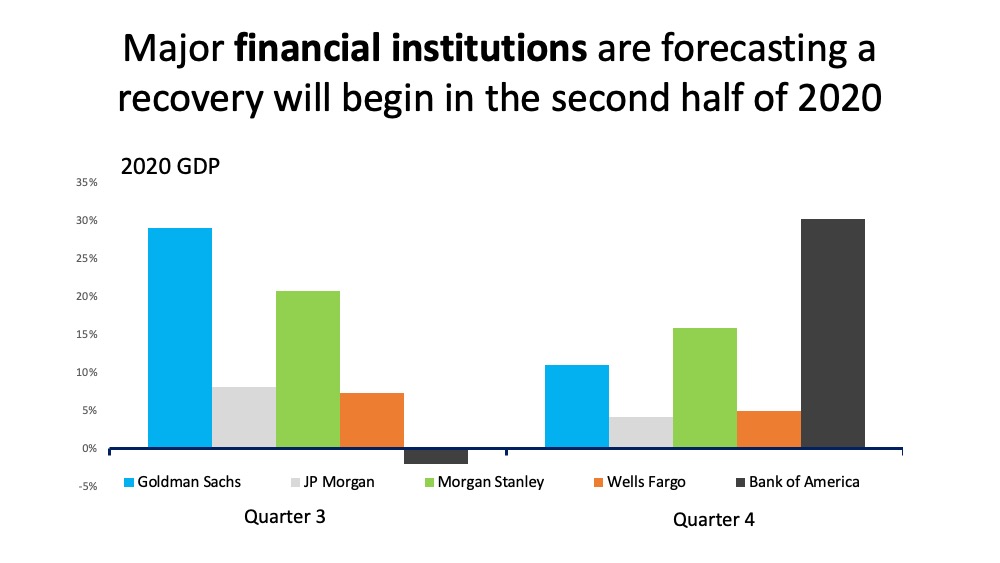
No one can answer this question with one hundred percent certainty. However, most top financial services firms are calling for a V-shaped recovery. Goldman Sachs, Morgan Stanley, Wells Fargo Securities, and JP Morgan have all recently come out with projections that call for GDP to take a deep dive in the first half of the year but have a strong comeback in the second half.Will This Economic Crisis Have a V, U, or L-Shaped Recovery? | MyKCM

Is there any research on recovery following a pandemic?

There have been two extensive studies done that look at how an economy has recovered from a pandemic in the past. Here are the conclusions they reached:

1. John Burns Consulting:

“Historical analysis showed us that pandemics are usually V-shaped (sharp recessions that recover quickly enough to provide little damage to home prices), and some very cutting-edge search engine analysis by our Information Management team showed the current slowdown is playing out similarly thus far.”

2. Harvard Business Review:

“It’s worth looking back at history to place the potential impact path of Covid-19 empirically. In fact, V-shapes monopolize the empirical landscape of prior shocks, including epidemics such as SARS, the 1968 H3N2 (“Hong Kong”) flu, 1958 H2N2 (“Asian”) flu, and 1918 Spanish flu.”

The research says we should experience a V-shaped recovery.

Does everyone agree it will be a ‘V’?

No. Some are concerned that, even when businesses are fully operational, the American public may be reluctant to jump right back in.

As Market Business News explains:

“In a typical V-shaped recovery, there is a huge shift in economic activity after the downturn and the trough. Growing consumer demand and spending drive the massive shift in economic activity.”

If consumer demand and spending do not come back as quickly as most expect it will, we may be heading for a U-shaped recovery.

In a message last Thursday, Chris Hyzy, Chief Investment Officer for Merrill and Bank of America Private Bank, agrees with other analysts who are expecting a resurgence in the economy later this year:

“We’re forecasting real economic growth of 30% for the U.S. in the 4th quarter of this year and 6.1% in 2021.”

His projection, however, calls for a U-shaped recovery based on concerns that consumers may not rush back in:

“After the steep plunge and bottoming out, a ‘U-shaped’ recovery should begin as consumer confidence slowly returns.”

Bottom Line

The research indicates the recovery will be V-shaped, and most analysts agree. However, no one knows for sure how quickly Americans will get back to “normal” life. We will have to wait and see as the situation unfolds.

April 22, 2020

The Pain of Unemployment: It Will Be Deep, But Not for Long

The Pain of Unemployment: It Will Be Deep, But Not for Long | MyKCM

There are two crises in this country right now: a health crisis that has forced everyone into their homes and a financial crisis caused by our inability to move around as we normally would. Over 20 million people in the U.S. became instantly unemployed when it was determined that the only way to defeat this horrific virus was to shut down businesses across the nation. One second a person was gainfully employed, a switch was turned, and then the room went dark on their livelihood.

The financial pain so many families are facing right now is deep.

How deep will the pain cut?

Major institutions are forecasting unemployment rates last seen during the Great Depression. Here are a few projections:

  • Goldman Sachs – 15%
  • Merrill Lynch – 10.6%
  • Wells Fargo – 7.3%

How long will the pain last?

As horrific as those numbers are, there is some good news. The pain will be deep, but it won’t last as long as it did after previous crises. Taking the direst projection from Goldman Sachs, we can see that 15% unemployment quickly drops to 6-8% as we head into next year, continues to drop, and then returns to about 4% in 2023.

When we compare that to the length of time it took to get back to work during both the Great Recession (9 years long) and the Great Depression (12 years long), we can see how the current timetable is much more favorable.The Pain of Unemployment: It Will Be Deep, But Not for Long | MyKCM

Bottom Line

It’s devastating to think about how the financial heartache families are going through right now is adding to the uncertainty surrounding their health as well. Hopefully, we will soon have the virus contained and then we will, slowly and safely, return to work.

April 21, 2020

How Technology is Helping Real Estate

How Technology is Helping Buyers Navigate the Home Search Process [INFOGRAPHIC] | MyKCM

Some Highlights:

  • A recent realtor.com survey revealed that buyers are still considering moving forward with the homebuying process, even if they can’t see the home in-person.
  • While they still prefer to physically see a home, virtual home tours and accurate listing information top the list of tech specs buyers find most helpful in today’s process.
  • Let’s connect today to determine how technology can help power your home search.
April 20, 2020

Today’s Homebuyers Want Lower Prices. Sellers Disagree.

Today’s Homebuyers Want Lower Prices. Sellers Disagree. | MyKCM

The uncertainty the world faces today due to the COVID-19 pandemic is causing so many things to change. The way we interact, the way we do business, even the way we buy and sell real estate is changing. This is a moment in time that’s even sparking some buyers to search for a better deal on a home. Sellers, however, aren’t offering a discount these days; they’re holding steady on price.

According to the most recent NAR Flash Survey (a survey of real estate agents from across the country), agents were asked the following two questions:

1. “Have any of your sellers recently reduced their price to attract buyers?”

Their answer: 72% said their sellers have not lowered prices to attract buyers during this health crisis. 

2. “Are home buyers expecting lower prices now?”

Their answer: 63% of agents said their buyers were looking for a price reduction of at least 5%.Today’s Homebuyers Want Lower Prices. Sellers Disagree. | MyKCM

What We Do Know  

In today’s market, with everything changing and ongoing questions around when the economy will bounce back, it’s interesting to note that some buyers see this time as an opportunity to win big in the housing market. On the other hand, sellers are much more confident that they will not need to reduce their prices in order to sell their homes. Clearly, there are two different perspectives at play.

Bottom Line

If you’re a buyer in today’s market, you might not see many sellers lowering their prices. If you’re a seller and don’t want to lower your price, you’re not alone. If you have questions on how to price your home, let’s connect today to discuss your real estate needs and next steps.

April 15, 2020

Recession? Yes. Housing Crash? No.

Recession? Yes. Housing Crash? No. | MyKCM

With over 90% of Americans now under a shelter-in-place order, many experts are warning that the American economy is heading toward a recession, if it’s not in one already. What does that mean to the residential real estate market?

What is a recession?

According to the National Bureau of Economic Research:

“A recession is a significant decline in economic activity spread across the economy, lasting more than a few months, normally visible in real GDP, real income, employment, industrial production, and wholesale-retail sales.”

COVID-19 hit the pause button on the American economy in the middle of March. Goldman Sachs, JP Morgan, and Morgan Stanley are all calling for a deep dive in the economy in the second quarter of this year. Though we may not yet be in a recession by the technical definition of the word today, most believe history will show we were in one from April to June.

Does that mean we’re headed for another housing crash?

Many fear a recession will mean a repeat of the housing crash that occurred during the Great Recession of 2006-2008. The past, however, shows us that most recessions do not adversely impact home values. Doug Brien, CEO of Mynd Property Management, explains:

“With the exception of two recessions, the Great Recession from 2007-2009, & the Gulf War recession from 1990-1991, no other recessions have impacted the U.S. housing market, according to Freddie Mac Home Price Index data collected from 1975 to 2018.”

CoreLogic, in a second study of the last five recessions, found the same. Here’s a graph of their findings:Recession? Yes. Housing Crash? No. | MyKCM

What are the experts saying this time?

This is what three economic leaders are saying about the housing connection to this recession:

Robert Dietz, Chief Economist with NAHB

“The housing sector enters this recession underbuilt rather than overbuilt…That means as the economy rebounds – which it will at some stage – housing is set to help lead the way out.”

Ali Wolf, Chief Economist with Meyers Research

“Last time housing led the recession…This time it’s poised to bring us out. This is the Great Recession for leisure, hospitality, trade and transportation in that this recession will feel as bad as the Great Recession did to housing.”

John Burns, founder of John Burns Consulting, also revealed that his firm’s research concluded that recessions caused by a pandemic usually do not significantly impact home values:

“Historical analysis showed us that pandemics are usually V-shaped (sharp recessions that recover quickly enough to provide little damage to home prices).”

Bottom Line

If we’re not in a recession yet, we’re about to be in one. This time, however, housing will be the sector that leads the economic recovery.

April 14, 2020

What You Can Do to Get Your House Ready to Sell

What You Can Do to Get Your House Ready to Sell | MyKCM

Some Highlights:

  • Believe it or not, there are lots of things you can do to prep your house for a sale without even going to the store.
  • Your real estate plans don’t have to be completely on hold even while we’ve hit the pause button on other parts of daily life.
  • Tackling small projects from cleaning the corners you may normally skip to tidying up your yard are easy and necessary wins if you’re thinking of listing your house and making a move.
Posted in Home Tips, Selling